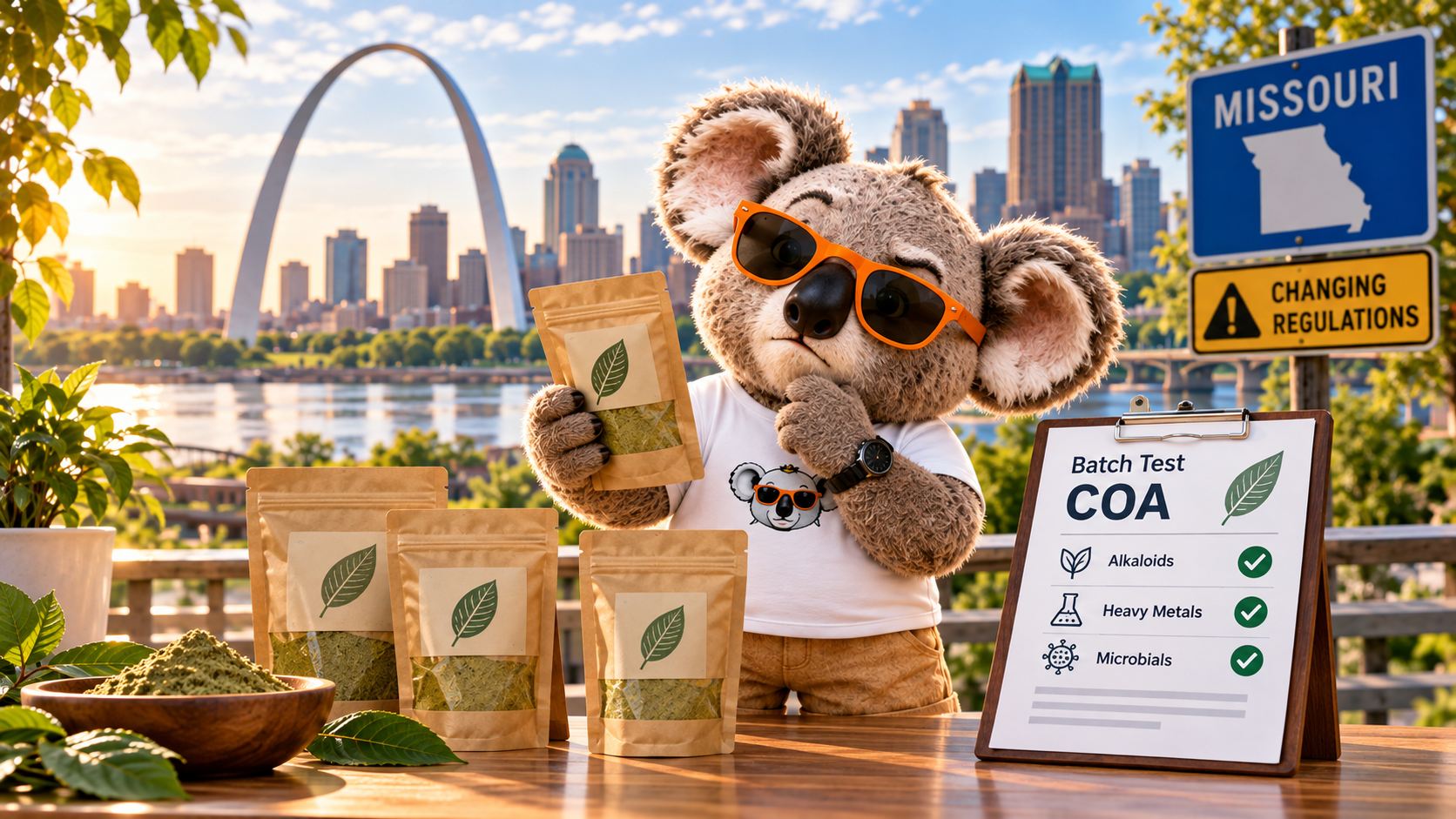
Can You Still Buy Kratom in St. Louis? What Missouri Buyers Need to Know
If you have tried to buy kratom in St. Louis recently, you may have noticed that the answer to a seemingly simple question has become surprisingly complicated.
Can you still buy kratom in Missouri?
Missouri has not enacted a blanket statewide prohibition on natural kratom. But the state has become one of the more active places in the country when it comes to kratom enforcement, particularly around concentrated alkaloid products such as 7-hydroxymitragynine, commonly called 7-OH.
That distinction matters.
It also means St. Louis buyers should probably be paying more attention to what they are buying, who they are buying it from, and what the laboratory testing actually shows.
What Is Happening With Kratom in Missouri?
Missouri’s kratom market changed significantly in 2026.
The Missouri Attorney General’s Office has pursued manufacturers, distributors and retailers selling kratom and concentrated kratom alkaloid products. Some of those cases have resulted in individual businesses agreeing to suspend sales within Missouri.
In June 2026, American Shaman agreed to suspend all in-state sales of kratom and its alkaloids as part of a settlement with the Missouri Attorney General’s Office. In August, the St. Louis-area distributor Green Dragon also agreed to stop selling, distributing, marketing or advertising kratom products to Missouri consumers and distributors. Those agreements apply to the companies involved; they are not themselves a statute creating a blanket prohibition on every natural kratom product sold by every company in Missouri.
At the same time, Missouri lawmakers have considered legislation specifically regulating kratom. Senate Bill 927, for example, would restrict adulterated products, prohibit sales to anyone under 21, establish limits on 7-hydroxymitragynine concentration, require specified labeling and prohibit certain product formats. As of the current legislative record, the proposal has advanced through committee but is not evidence of a blanket statewide ban on natural kratom.
In other words, the situation is not as simple as either:
“Kratom is banned in Missouri.”
or
“Nothing has changed.”
Something has definitely changed.
St. Louis Buyers Need to Know What Kind of Kratom They Are Looking At
One reason the current discussion gets confusing is that the word kratom is being used to describe products that can be very different from one another.
Traditional kratom powder is dried and milled Mitragyna speciosa leaf.
The modern market also contains extracts, concentrated alkaloid products, 7-OH products and other formulations that may contain dramatically different concentrations than traditional leaf powder.
Missouri regulators have focused heavily on these concentrated alkaloid products. The Attorney General’s recent actions repeatedly reference 7-OH and other kratom-derived or related alkaloids, although some settlements have extended more broadly to kratom products sold by the companies involved.
For a customer standing in a St. Louis smoke shop, convenience store or botanical store, that means one thing:
Read the label.
Better yet, read the laboratory report.
Where Can You Buy Kratom in St. Louis?
Kratom products have historically been available around St. Louis through smoke shops, vape stores, specialty botanical retailers and online vendors.
But given the current enforcement environment in Missouri, inventory can change quickly. A store that carried a particular brand or product previously may no longer carry it, and individual distributors may be subject to agreements or enforcement actions that do not apply to every seller in the state.
That makes it difficult to treat a static list of “best kratom stores in St. Louis” as permanently accurate.
If you are shopping locally, call the retailer first and ask whether they currently carry traditional natural-leaf kratom powder, what brands they stock and whether batch-specific laboratory reports are available.
If you are considering ordering online, verify that the vendor currently ships the specific product to Missouri and review the product’s testing before placing an order.
Smoke Shop Kratom vs. Buying Kratom Online
Buying locally has one obvious advantage: convenience.
You can walk into a store, see the package and leave with the product immediately.
What you cannot necessarily determine from looking at the package is how recently the product was tested, whether the laboratory report belongs to the lot sitting on the shelf, or how long that inventory has been there.
That is where buying from a transparent online vendor can have an advantage.
A good online product page can provide access to the current batch information, laboratory testing and product details before you place the order.
But “online” does not automatically mean better.
A polished website without meaningful testing is still just a polished website.
Whether you buy kratom in St. Louis or order it online, the same standard should apply:
Look at the product. Look at the batch. Look at the testing.
Don’t Choose Kratom Based Only on the Strain Name
This matters especially when you are shopping somewhere with a huge wall of kratom packages.
Green Maeng Da.
Red Bali.
White Dragon.
Yellow Vietnam.
Super Green.
Premium Reserve.
The names make the products look highly specific.
They are not chemical specifications.
Commercial kratom strain names are not standardized in a way that guarantees that one vendor’s Green Maeng Da has the same alkaloid profile as another vendor’s Green Maeng Da.
The same caution applies to Red, Green and White.
Those categories can be useful for identifying products and communicating preferences, but they do not replace laboratory analysis.
If you want to know what was actually measured in a batch, the front of the bag is not where you find that answer.
The COA is.
What Should a St. Louis Kratom Buyer Look For?
Start with a batch-specific Certificate of Analysis, or COA.
A useful laboratory report can provide measurable information such as mitragynine concentration, 7-hydroxymitragynine where tested, heavy-metal results, microbial testing, the laboratory that performed the analysis and an identifier connecting the report to a particular batch or lot.
Those details matter much more than whether the manufacturer called the product “Super Premium Green Dragon.”
The current Missouri regulatory environment makes that distinction even more important.
If regulators are scrutinizing concentrated alkaloids and product composition, consumers should be asking the same basic question:
What is actually in this product?
Pay Particular Attention to 7-OH
If you are buying kratom in Missouri right now, this deserves special attention.
7-hydroxymitragynine, or 7-OH, has been at the center of much of Missouri’s recent regulatory and enforcement activity.
The Missouri Attorney General’s Office has repeatedly distinguished concentrated 7-OH and related alkaloid products as a major focus of its actions, and proposed legislation would establish concentration limits for 7-OH in kratom products.
That is very different from assuming every product containing naturally occurring kratom alkaloids is chemically identical.
If the product you are considering does not clearly tell you whether it is traditional leaf powder, an extract or a concentrated alkaloid product, that should be a reason to slow down and find out.
“Lab Tested” Is Not Enough
This phrase appears everywhere in the kratom market.
LAB TESTED.
Sounds reassuring.
But what exactly was tested?
An alkaloid panel tells you something about alkaloids.
It does not automatically tell you anything about microbial contamination.
A microbial panel does not automatically tell you about heavy metals.
A report from an old batch does not automatically describe the inventory being sold today.
And a COA with no clear connection to the product or lot in front of you is much less useful than a report tied to the actual batch.
When evaluating kratom in St. Louis, ask whether the testing covers alkaloids, heavy metals and microbials, and whether you can connect that report to the product being sold.
What About Buying Kratom Online in St. Louis?
For buyers who cannot find the type of traditional leaf product they want locally, online vendors remain another avenue to investigate.
The advantage is selection and access to information.
Before ordering, however, confirm that the seller currently ships to Missouri. The state’s regulatory environment is evolving, and individual vendors may make different decisions about whether they will accept Missouri orders.
A vendor willing to ship somewhere is also not, by itself, proof that every product it sells complies with every applicable requirement.
Do your homework.
For natural leaf powder, look for clear product identification, batch numbers, current laboratory results and transparent contact information.
Avoid assuming that a giant strain catalog means better quality.
Twenty-five clever names do not replace one good batch.
Missouri’s Rules May Continue to Change
This is one page where the date matters.
As of September 2026, Missouri lawmakers have considered legislation regulating kratom products, including proposed restrictions involving age, labeling, adulteration and 7-OH concentration. Meanwhile, the Attorney General’s Office has continued taking enforcement actions and negotiating agreements with individual sellers.
Anyone buying or selling kratom in Missouri should therefore check current state and local requirements rather than relying on an article written years ago saying simply that kratom is “legal in Missouri.”
The situation is more nuanced now.
Why Batch Testing Matters More Than Ever
The easiest mistake consumers can make is spending too much time asking:
Which strain should I buy?
A better question is:
Which batch am I buying?
Kratom is botanical material. Batches can vary.
The product name can stay exactly the same while the material behind that name changes over time.
Testing gives you information about the sample that was actually analyzed. It does not make a botanical product perfectly predictable, but it gives you considerably more objective information than a strain name or package design.
That becomes especially important in a market like Missouri, where product composition has become part of the regulatory conversation.
Frequently Asked Questions About Buying Kratom in St. Louis
Is kratom banned in Missouri?
Missouri has not enacted a simple blanket statewide prohibition on all natural kratom leaf. However, the state has an unusually active enforcement environment, individual businesses have agreed to stop selling kratom products in Missouri, and lawmakers have considered additional statewide regulation. Buyers should verify current rules and product availability before purchasing.
Can I buy kratom in St. Louis?
Availability depends on the retailer, product and current regulatory environment. Some Missouri distributors and retailers have stopped selling kratom following enforcement actions or settlements. Check with the seller directly before visiting or ordering.
Is 7-OH the same as regular kratom powder?
No. Concentrated 7-OH products can contain very different concentrations of 7-hydroxymitragynine from traditional natural-leaf powder. Missouri regulators have specifically focused significant enforcement attention on 7-OH and related concentrated alkaloid products.
Should I buy kratom locally or online?
Either can work. The important question is whether you can evaluate the product and its current batch. Look for accessible laboratory testing, lot identification, contaminant screening and clear information about what type of product you are buying.
What should I look for on a kratom lab report?
Look for a batch or lot identifier, alkaloid results, heavy-metal testing, microbial testing, the testing laboratory and the date of analysis. Make sure the report actually corresponds to the product you are considering.
Buying Kratom in St. Louis Comes Down to Knowing What You’re Buying
Missouri is not the place to shop blindly right now.
That may actually be a good thing.
Consumers should know whether they are buying traditional leaf powder, an extract or a highly concentrated alkaloid product. They should know whether the batch was tested. They should be able to see what the laboratory measured.
The package name is secondary.
At Koala T Herbals, our focus is straightforward: natural kratom powder, batch-specific information and laboratory testing you can actually review.
If you are shopping for kratom in St. Louis, do not just ask who has it.
Ask the better questions.
What is it? What batch is it? And what does the lab report say?