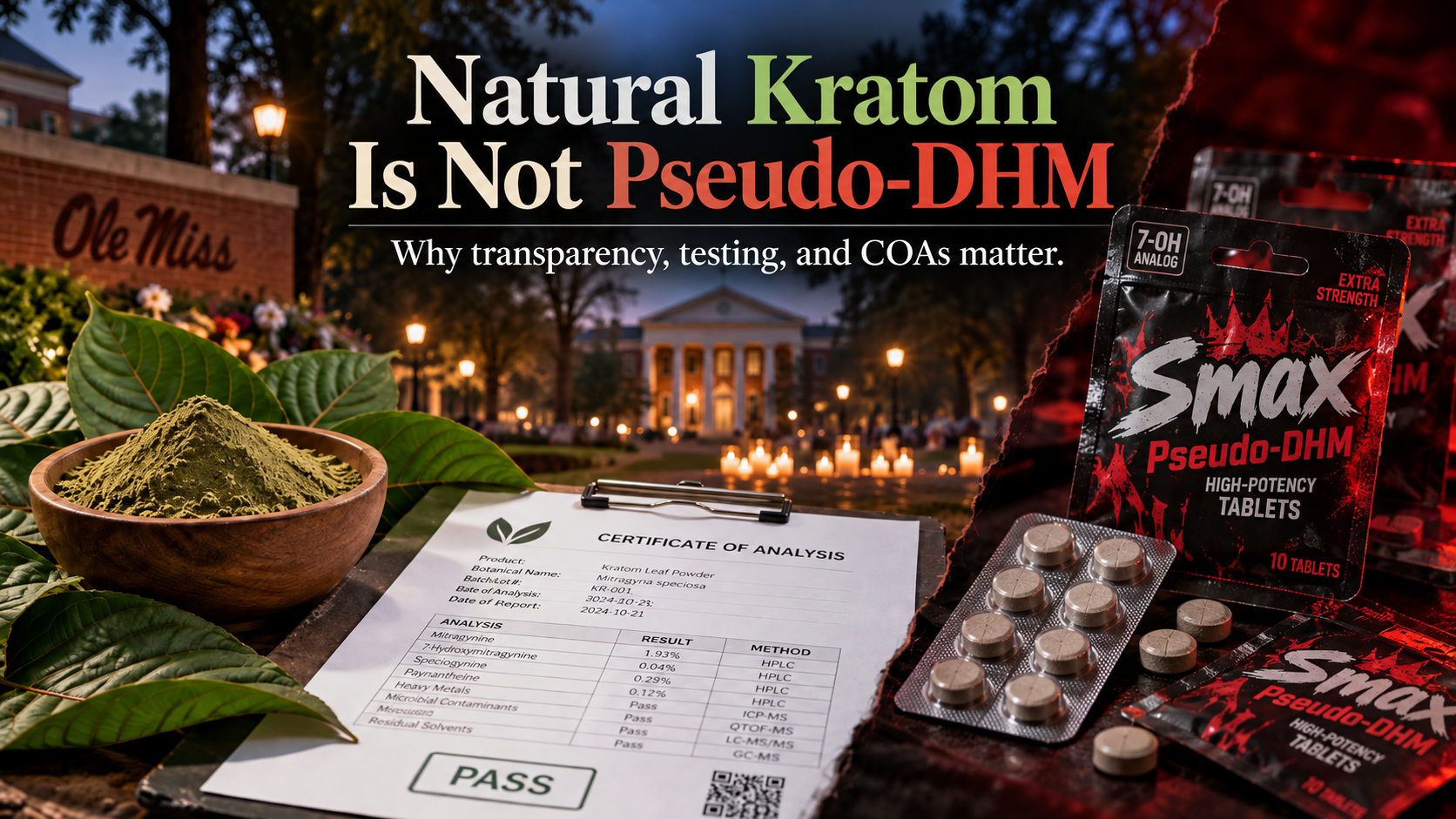
Ole Miss Deaths: Why Natural Kratom Is Not the Same as Pseudo-DHM
The recent deaths of two University of Mississippi students are tragic. Families lost their sons, friends lost people they cared about, and an entire campus was left searching for answers.
But as this story unfolded, one word quickly dominated the headlines:
Kratom.
The American Kratom Association pushed back — and for good reason.
From the beginning, authorities acknowledged that packaged products identified as kratom had been recovered during the investigations, while also stating that they had not confirmed kratom, or any other substance, as a contributing factor in either death.
Yet much of the early public discussion treated “kratom” as though that settled the question.
It didn't.
The AKA Asked a Simple Question: What Was Actually in the Package?
The American Kratom Association publicly called on authorities to identify and independently test the products recovered in the investigations.
The organization specifically asked officials to distinguish natural kratom leaf from concentrated, chemically manipulated or synthetic kratom-related products.
That distinction became increasingly important as additional information emerged.
According to subsequently released law-enforcement records and reporting, the products reportedly purchased by both students were Smax Pseudo-DHM tablets — not traditional natural kratom leaf powder.
That distinction should not be buried in the story.
It should be at the center of it.
Natural Kratom Leaf Is Not the Same Thing as Pseudo-DHM
Traditional kratom comes from the leaf of the Mitragyna speciosa tree, which is typically dried and ground into powder.
That is very different from a tablet formulated around highly concentrated or chemically altered kratom-related compounds.
The products identified in the Ole Miss investigation were reportedly labeled as containing substances including 7-hydroxymitragynine, mitragynine pseudoindoxyl and related compounds.
The AKA has repeatedly argued that products like these should not simply be grouped together with traditional natural kratom leaf.
Using “kratom” as a catch-all term makes it difficult for consumers to understand the difference between a traditional botanical product and a newer product containing concentrated or modified alkaloids.
That difference matters.
The Initial Messaging Matters Too
The AKA has also criticized how long it took for the specific products involved to be publicly identified.
Its argument is straightforward:
If authorities are investigating a specific high-potency tablet, the public should know what product is actually under investigation rather than simply hearing a broad warning about “kratom.”
That matters for public safety.
It also matters for millions of consumers who may otherwise assume that ordinary natural kratom leaf and highly concentrated derivative products are essentially the same thing.
They are not.
We Still Don't Have the Final Answer
It is equally important not to run ahead of the evidence in the opposite direction.
Investigators have not yet publicly established the precise role the Smax products played in either death.
Other substances and circumstances have also reportedly been part of the investigation.
So the responsible conclusion is not that traditional kratom caused these deaths.
Nor is it that any single product has definitively been proven responsible.
The responsible conclusion is much simpler:
Identify the product accurately. Test it. Report what is actually in it. Then follow the evidence.
Why This Matters to Koala T Herbals
This situation reinforces something we believe strongly at Koala T Herbals:
Consumers deserve to know what they are buying.
Koala T Herbals focuses on traditional natural kratom leaf powder — not Pseudo-DHM tablets or products formulated around concentrated 7-OH or similar modified compounds.
But simply saying that isn't enough.
Transparency has to be demonstrated.
That's why independent laboratory testing and Certificates of Analysis matter.
A COA gives customers something more meaningful than marketing language. It provides documentation about the actual product being sold, including testing for important factors such as alkaloid content, heavy metals and microbial contamination.
At Koala T Herbals, we believe customers should be able to see that information for themselves.
We don't believe consumers should have to wonder what's in the bag.
We don't believe vendors should hide behind vague descriptions.
And we don't believe radically different products should all be lumped together under the same word simply because they are connected in some way to the kratom plant.
Transparency Isn't Just a Selling Point
Stories like this are exactly why transparency within the kratom industry matters.
A responsible market requires clear product identification, responsible labeling, independent testing and accessible laboratory results.
That protects consumers.
It also helps distinguish legitimate natural kratom products from an expanding category of concentrated and chemically modified products that can look very different from traditional leaf.
The American Kratom Association was right to demand greater specificity in the Ole Miss investigation.
Because when a tragedy occurs, facts matter.
What the product actually is matters.
What is actually in it matters.
And whether consumers can verify that information matters.
That's why Koala T Herbals will continue putting transparency, testing and accessible COAs at the center of what we do.
Know your product. Know your vendor. Know what you're buying.